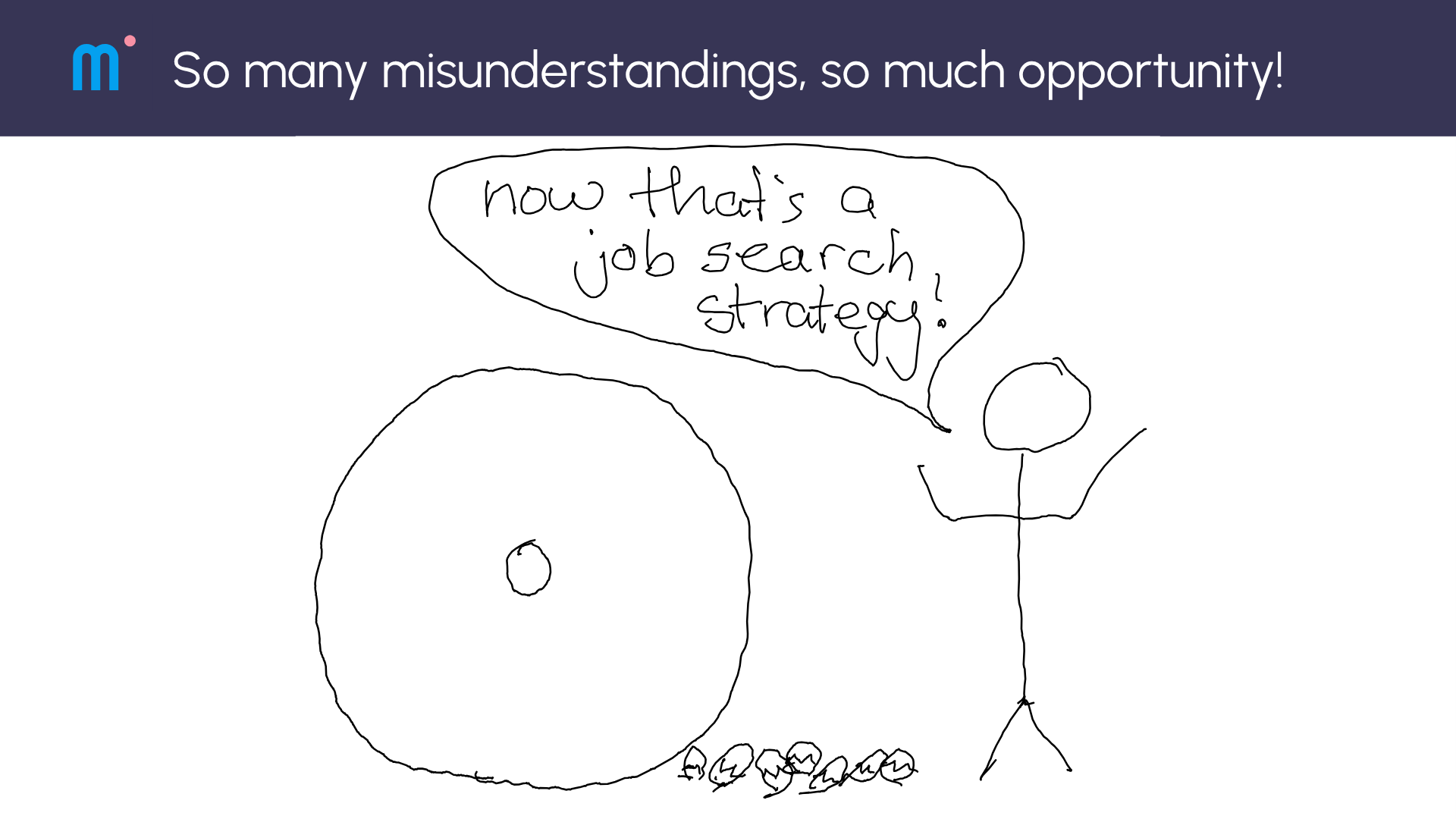
An ancient military text describes the epitome of strategy this way: a millstone rolling over eggshells. Unstoppable. Inevitable. Effortless.
Most job seekers are the eggshells.
A few — the ones who understand what's actually happening — are the millstone.
Here's the difference.
The problem everyone thinks is yours
You're looking for a job. The employer has the job. Therefore, you have the problem and they have the solution.
That's the default frame. And it puts you in a terrible position — competing, persuading, performing, hoping.
But let me offer you a creativity move: flip it.
What if the employer has the problem, and you are the solution?
Because right now, they genuinely do have a problem. A serious one.
What's actually happening on the other side of the hiring desk
Seven HR managers were recently interviewed across Ottawa about their biggest challenges. What came back was striking.
Resumes? Unreliable. AI tools allow candidates to reverse-engineer any job posting and produce a perfectly tailored application in seconds. One HR director described receiving hundreds of applications where 25% looked genuinely strong — and she couldn't tell which ones were real. "It's really hard when you're looking at a resume and it's like, 'I have 10 resumes that are perfectly tailored to this job. Is this actually authentic experience or not?'"
Interviews? Compromised. Candidates are running AI listening apps in real time, feeding questions through the tool and reading the generated answer back. One recruiter caught a candidate scrolling ChatGPT on smart glasses mid-call. Another heard the telltale pause — just long enough for an AI to think — before the perfect answer arrived.
References? Long since discredited. Everyone puts forward people who will speak well of them.
Degrees? At the bottom of the priority list. Most organizations have deprioritized them in favour of real-world evidence of what someone can actually do.
What they are looking for — and struggle most to assess — is critical thinking and cultural fit. One VP of HR said without hesitation: "I would make it easier to assess the level of critical thinking ability. It's a really hard thing to figure out in a one-hour interview if the person has it or not."
This is the employer's problem. And it's your opportunity.
The creativity move: solve the opposite problem
Let's open the creativity recipe book and pull out a classic: solve the opposite problem.
The opposite of "how do I look more qualified?" is "how can I actually be more capable?"
The opposite of "how do I produce a better AI-assisted resume?" is "how do I become the person no AI can impersonate?"
The opposite of "how do I get through the interview?" is "how do I give the employer something they can actually trust?"
This is the millstone move. While everyone else optimizes appearances, you build reality. And reality rolls through a field of manufactured impressions like a millstone through eggshells.
What this looks like in practice
My previous article explored how new hires now enter at the middle — not the bottom. Entry-level tasks are disappearing. AI has absorbed the low-stakes practice reps that used to turn new grads into competent professionals over time. The door into organizations has moved five floors up.
This means the skills that matter most aren't the ones you list on a resume. They're the ones you demonstrate in a room — or before you ever get to the room.
The leadership power skills: creativity, initiative, emotional intelligence, and critical thinking. These can't be AI-generated. They can't be faked through a listening app. And they are precisely what employers say they can't find, can't test for, and desperately need.
Here's how you use them in the job search itself:
Creativity: Don't apply to the job as described. Research what problem that role actually exists to solve. Then make your application about solving that problem. One relevant insight about their challenge is worth more than ten perfectly-keyworded bullet points.
Initiative: Don't wait for the interview to demonstrate you can act. Before the conversation, find one small thing in their world that you can speak to with genuine curiosity or insight. What they really want to see is whether you can reason through unfamiliar situations — not just produce the right-sounding answer. Give them that before they ask for it.
Critical thinking: Ask better questions than they expect. Show how you see the problem they're trying to solve. One HR director described adding situational questions to every prescreen: "What would you do if you showed up to the event and the equipment wasn't there?" What she's looking for isn't the right answer — it's the ability to think out loud about an unfamiliar situation. Practice that. Do it before someone asks.
Emotional intelligence: Understand that the people across the table are in survival mode. They're not looking for someone to impress them. They're looking for someone to trust. Show up in a way that reduces their risk, rather than performing for their admiration.
The deeper move: be, rather than appear to be
There's a Latin word: esse. It means to be. As opposed to videri — to seem or appear.
The entire job search industry has optimized for videri. Better-looking resume. Stronger LinkedIn headline. More compelling cover letter. And now, AI has made videri available to everyone, instantly, for free.
Which means videri is now worthless.
What employers are hungry for — and what almost no one is offering — is esse. The real thing.
Not assets that persuade them of what they want you to be capable of. But genuine development of what you are actually capable of.
The people that actually make it past that stage and decide to take action are the exact kind of people that you would want to hire. That's the filter. Not the resume. Not the interview script. The willingness to do the real work of developing yourself, not just representing yourself.
The move others won't make: practice instead of learn
Here's what makes this different from most job search advice — including the good kind.
Most advice is about knowing more. Better strategies. Smarter frameworks. More polished answers. And knowing more has value. But there's a problem with it.
Under pressure — in the actual interview, in the first week on the job, in the moment someone puts you on the spot — you don't rise to your knowledge. You fall back to your training.
That gap between knowing and doing is where most candidates lose the edge they thought they had. They know what good critical thinking looks like. They've read about emotional intelligence. But when the moment comes, they default to the familiar.
The millstone move isn't learning more about creativity, initiative, emotional intelligence, and critical thinking. It's practicing them — in real, low-stakes situations — before the high-stakes ones arrive.
That means doing something imperfect and uncertain today. Reaching out to someone you don't know. Asking a question in a room where you might look naïve. Applying for the role that feels like a stretch. Taking a position in a conversation and defending it. Not to perform — to build the pathways that show up automatically when it counts.
Others are consuming content about this. You are doing this.
That's the real edge that makes you stand out in the middle.
When you’re in the middle — don’t try harder
There's a reason most people feel overlooked in the job search. It's not that the market is unfair (though it has friction). It's that the market is full of people doing the same things in the same ways and hoping for different outcomes.
The middle is crowded. And the reality is you’re in it. There are always others who can perform better, with more experience, and better qualifications.
But here's the critical insight: you don't stand out by performing better at the same game. You stand out by playing a different game.
Uncertain, imperfect, uncomfortable action. That's the game. To have what others don't, you have to do what others won't.
The millstone doesn't try hard. It just moves.
If you're navigating the school-to-work transition and want to approach it differently, DM me on LinkedIn. I’m serious about helping individuals who are ready to shift from optimizing appearances and collecting knowledge, to practicing the abilities that give you the edge. Leader Lab is a place where that practice happens.