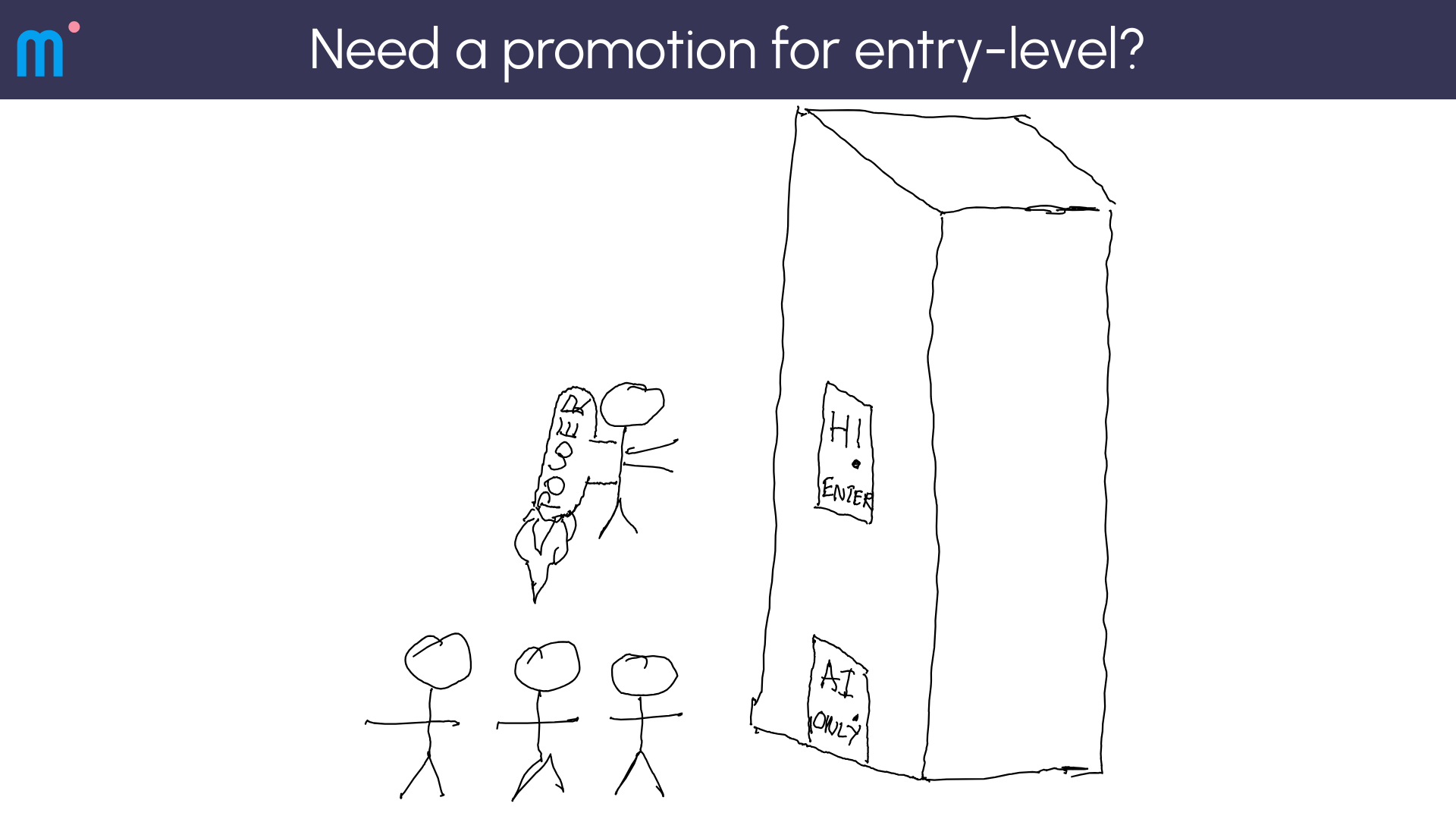
Picture a building with no door on the ground floor. The only entrance is five stories up.
That’s what early careers feel like right now.
Goodbye bottom rungs
Entry level tasks are disappearing. Which raises the bar for new hires. They need to perform like competent mid-level workers.
Putting in the time and paying your dues on the ubiquitous lower rungs of the career ladder was once a right of passage. It was the assumed way of building competence through practical experience.
Like a winter vacationer at the tanning salon prepping for the tropics, you were gradually exposed to increasing levels of responsibility so you wouldn’t get burned.
Some think the solution is spreading 60 SPF CYA on thick. The thing is, we need those who take responsibility and protect others, rather than deny, avoid, blame, and shame. Where can you practice those relationship power skills?
Enter the middle
We’ve always wanted fresh talent that performs like more seasoned workers. That’s why many organizations have invested heavily in pathways that launch talent into the middle.
I fondly remember leading a two week bootcamp program that immersed computer science interns in the joys and perils of team software development, and set them up to make as many novice mistakes as possible—before joining their product teams.
Then there were the mixed teams of technical and business interns who had to build the technology and business case for real emerging business opportunities and pitch them at corporate headquarters. You learn a lot very fast when each day is 2% of the project, the stakes are high, egos and assumptions abound, and no one has the answers.
These kinds of programs were meant to accelerate the careers and impact of the best and brightest, letting them skip entry level entirely.
Today’s opportunity is creating an experience-based mid-entry mentoring and apprenticeship path for your early career professionals. And it’s not about “more training”.
Relationship power skills
Back in the 80s I was just some kid cleaning the gas pumps at 3 am. Bottom rung.
Then, in rolled the evening’s entertainment.
A luxury sedan pulls up midway on the outside, blocking both outside pumps at the otherwise empty station. A cube van rental turns in moments later. It creeps up to the sedan’s bumper, honks angrily, and the sedan moves off.
Truck guy has no idea that the high end Mercedes takes diesel. Things escalate fast, so it’s a bit late to say something, and besides, I’m just a kid doing wax on wax off. Bottom rung.
The Mercedes guy pulls around to me and rolls down his window, asks why there’s no room for people like him in this country, and then drives off. Truck guy fills up with gas, then stops to tell me how people like Mercedes guy always act like they own the place.
I learned all kinds of relationship power skills at that gas station. How quickly a simple misunderstanding can balloon, filtered through our past experiences. That I wasn’t a nobody. The fact they both talked to me was proof that my gas station uniform gave me the authority to resolve the situation.
I could have headed the truck off when I saw what was coming. “You’d have no way of knowing, but that guy’s car runs on diesel, so he absolutely has to stop there to fill up. I appreciate you respecting the signs that say trucks must fill up on the outside. But there’s no need for you to wait. I’m standing right here, no problem with obstructed view, so please fill up at any pump you like.”
Of course, that exact situation never happened again. But lots of others did. Gradually, my “what I should have done” reflections helped me build the mental muscle memory to act with confidence and courage in the moment.
Practice, not knowledge
Today, I’d go so far as to say that the meaning of your life is found in choosing curiosity over fear in progressively more challenging situations. You need to practice doing it to see the benefit, and to get the confidence to do it more.
So please don’t expect the problem to be solved by a half-credit course in work readiness.
It’s about providing the mentoring needed in real life moments, so those who’ve joined in the middle can learn power skills lessons faster, more intentionally, and with a bit more of a safety net. That’s better for everyone.
The stakes today are too high for sink or swim. Those joining organizations now are starting in the ocean, not a swimming pool. We need the fresh ideas and approaches they bring more than ever. Don’t let them drown. Or get eaten by sharks.