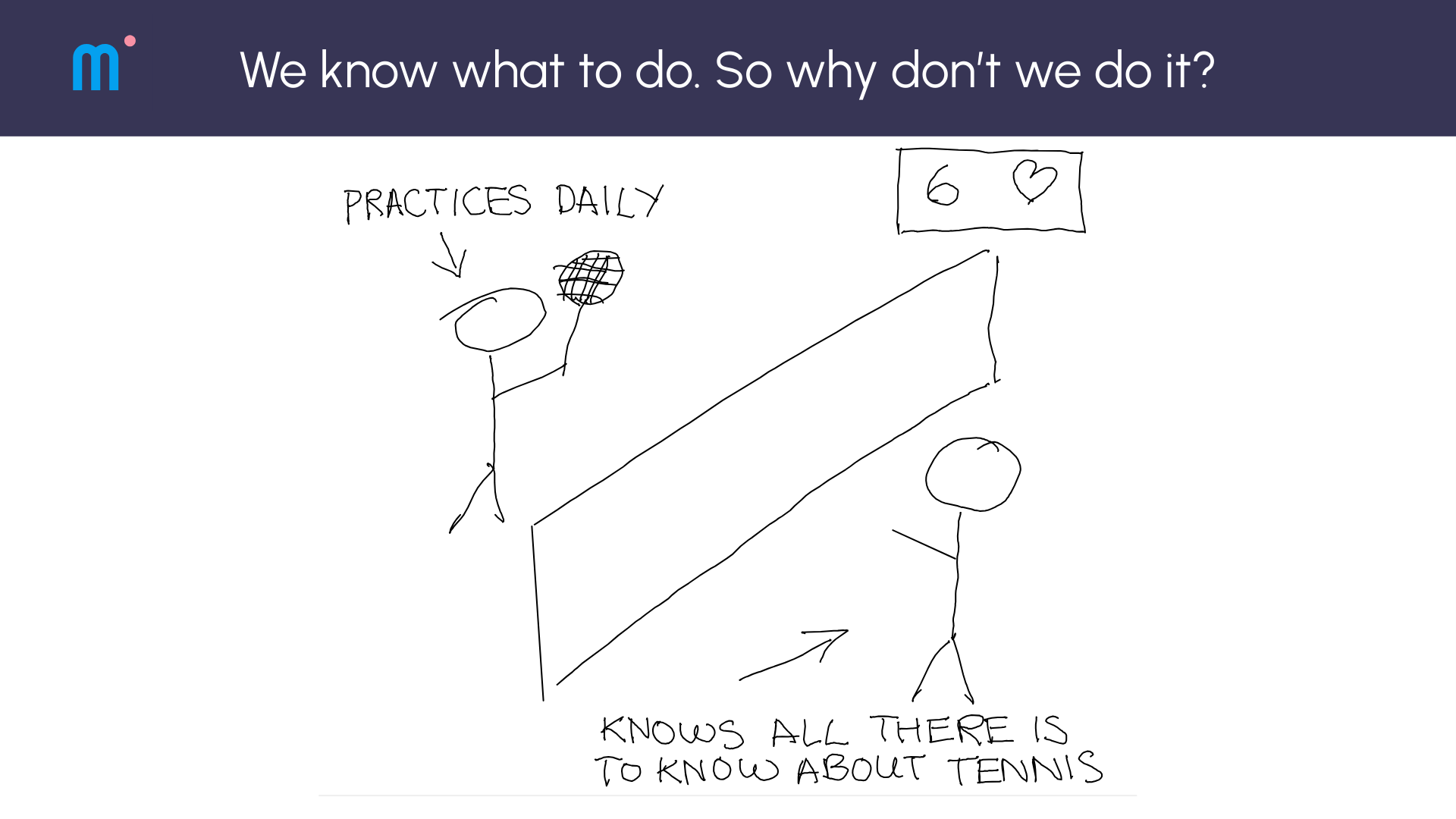
Leadership isn’t what you know. It’s what you do under pressure.
We don’t rise to our knowledge. We fall back to our training.
Many of us came up believing that if we just understood leadership well enough, we’d become good at it. Read the books, learn the models, build the frameworks—and the rest would follow. We’d know what to do, and then we’d do it. It’s a comforting idea, especially for those of us who’ve succeeded by thinking our way through problems.
Except that’s not what happens.
In the moments that matter most—when tension rises, when stakes are high, when something feels unfair—we don’t reach for what we know. We react. We interrupt when we meant to listen, shut down when we meant to engage, push when we meant to create space. We know better, but we don’t do better. That gap—between knowing and doing—is where leadership is actually won or lost.
We don’t rise to our knowledge
There’s a truth that shows up in every performance domain, from sports to music to emergency response: under pressure, we don’t rise to our knowledge—we fall back to our training. Leadership is no exception. We can know we should stay calm, be curious, regulate our emotions, and invite dissent. But when the moment hits, we don’t access a framework—we default to what’s most practiced.
That’s both the problem and the opportunity.
Leadership is not a knowledge problem
For years, many of us have treated leadership as something we learn. Courses, books, and offsites give us language, perspective, and useful models. They help us see what good looks like, and they matter more than we sometimes admit. But they don’t change how we behave when it counts.
Leadership isn’t built by learning what to do. It’s built by practicing how to behave—especially when it feels unnatural, uncomfortable, and we’re likely to get it wrong. That’s the part most of us quietly avoid, even as we invest heavily in everything around it.
Why this matters more than we think
What we practice early becomes what we rely on later. Our habits don’t just shape our behavior—they shape our results, our reputation, and our resilience under pressure. Over time, repeated patterns become default pathways, the ones we reach for without thinking. And those defaults are what others experience as “our leadership.”
The catch is that the habits that hold us back don’t feel wrong. They feel natural, because they are well-practiced. If we don’t build the right habits early, we don’t just plateau—we accumulate costly unlearning. Many experienced leaders aren’t learning new skills; they’re trying to undo deeply ingrained ones that once worked, but no longer do.
Emotional intelligence is behavioral
This is where many of us get tripped up, especially those who pride themselves on insight and awareness. We treat emotional intelligence as something we understand, something we can reason through or analyze. We assume that if we can name it, we can do it.
In practice, emotional intelligence is behavioral. It’s not proven by what we know—it’s proven by how we show up when it’s hardest to show up that way. When we’re challenged, frustrated, or under scrutiny, that’s when it counts. Not our intentions, not our models—our actions.
Complex problem, simple solution
Leadership is complex, situational, and deeply human, shaped by context, relationships, and timing. It resists formulas and doesn’t yield to one-size-fits-all answers. That’s part of what makes it both challenging and endlessly interesting. Yet, leadership development itself is far simpler than we tend to make it.
It doesn’t come from grand strategies. It comes from tactics—small, repeatable practices applied consistently over time.
We can’t rehearse every possible scenario, but we can practice small, consistent behaviors. Pausing instead of reacting, asking one more question, naming what we’re noticing, staying in the conversation when we’d rather exit. These don’t look like much in isolation, but repeated over time, they become how we show up when it matters most.
Why this is so hard for us
If leadership is a skill, why don’t we practice it the way we would a sport or an instrument? Because leadership adds layers of difficulty that most other domains don’t. The feedback is delayed and ambiguous, so we’re not always sure how we did. The stakes are social, meaning our credibility, relationships, and identity are on the line. And perhaps most importantly, we can’t see ourselves clearly. The game footage is missing.
We can’t read the label from inside the jar. Leadership is co-created—it exists in how others experience us. That means we all have blind spots, and our intent doesn’t always match our impact. Without feedback and reflection, we simply reinforce what we’re already doing.
What breaks under pressure
When pressure hits, something predictable happens in all of us. Our brain shifts into protection mode, narrowing our attention and amplifying our emotional responses. In those moments, we don’t deliberate—we default. We reach for the patterns that are fastest, most familiar, and most practiced.
This isn’t a failure of intelligence or character. It’s a function of repetition. The behaviors that show up under pressure are the ones we’ve rehearsed, consciously or not. If we want different responses, we have to practice them before the pressure arrives.
Why we avoid the practice
Practice feels awkward, especially at first, and we know we’re going to do it imperfectly. It exposes us in front of others, often in moments where something already feels at risk. So we default to what we’re good at, what feels natural, what protects us in the moment. And every time we do, we’re not staying neutral—we’re reinforcing the very patterns that will eventually limit us.
Like my pencil grip. I learned to hold it with concave fingers. It’s objectively worse—less control, more strain. I know the correct way. But decades later, I still default to the wrong grip. Because it’s what I’ve practiced.
Practice is always happening, whether we’re intentional about it or not. Every avoided conversation, every reactive response, every moment we choose comfort over growth is a repetition. And repetition is what wires behaviour. Left unchecked, we build habits that feel right but show up later as missed results, strained relationships, and reduced resilience under pressure.
The opportunity—especially for emerging leaders—is that this works both ways. The earlier we start practicing the right behaviours, the less we have to unlearn later. Instead of spending years undoing ingrained patterns, we build ones that serve us from the start. Small, deliberate practice now compounds into instinct later, shaping not just how we lead, but how we’re experienced when it matters most.
What actually works
What works is surprisingly simple, though not easy.
We pick one behaviour—not a broad aspiration, but something small, specific, and observable. A pause before responding, a genuine follow-up question, a moment of naming what we’re noticing instead of jumping to judgment. Specificity beats general intention: “pause 2 seconds before responding,” not “be a better listener.” Then we practice it, deliberately and repeatedly.
We do it imperfectly, notice the impact, get feedback, and try again. Over time, what once felt forced starts to feel natural. It becomes automatic, part of how we show up without thinking.
Let’s do something about it
If leadership isn’t a knowledge problem, then knowing more won’t close the gap.
What helps is practice. Space to try things out, to get feedback, to build habits before the pressure is on. An environment where it’s safe to slow things down—like practicing a piano piece at half speed—so that when the real moment comes, we’re not relying on intention, but on what we’ve practiced.
That’s the spirit behind Leader Lab. Not another place to learn what to do, but a place to practice how we actually show up.
You can keep reading about leadership. And you can start practicing—with others.