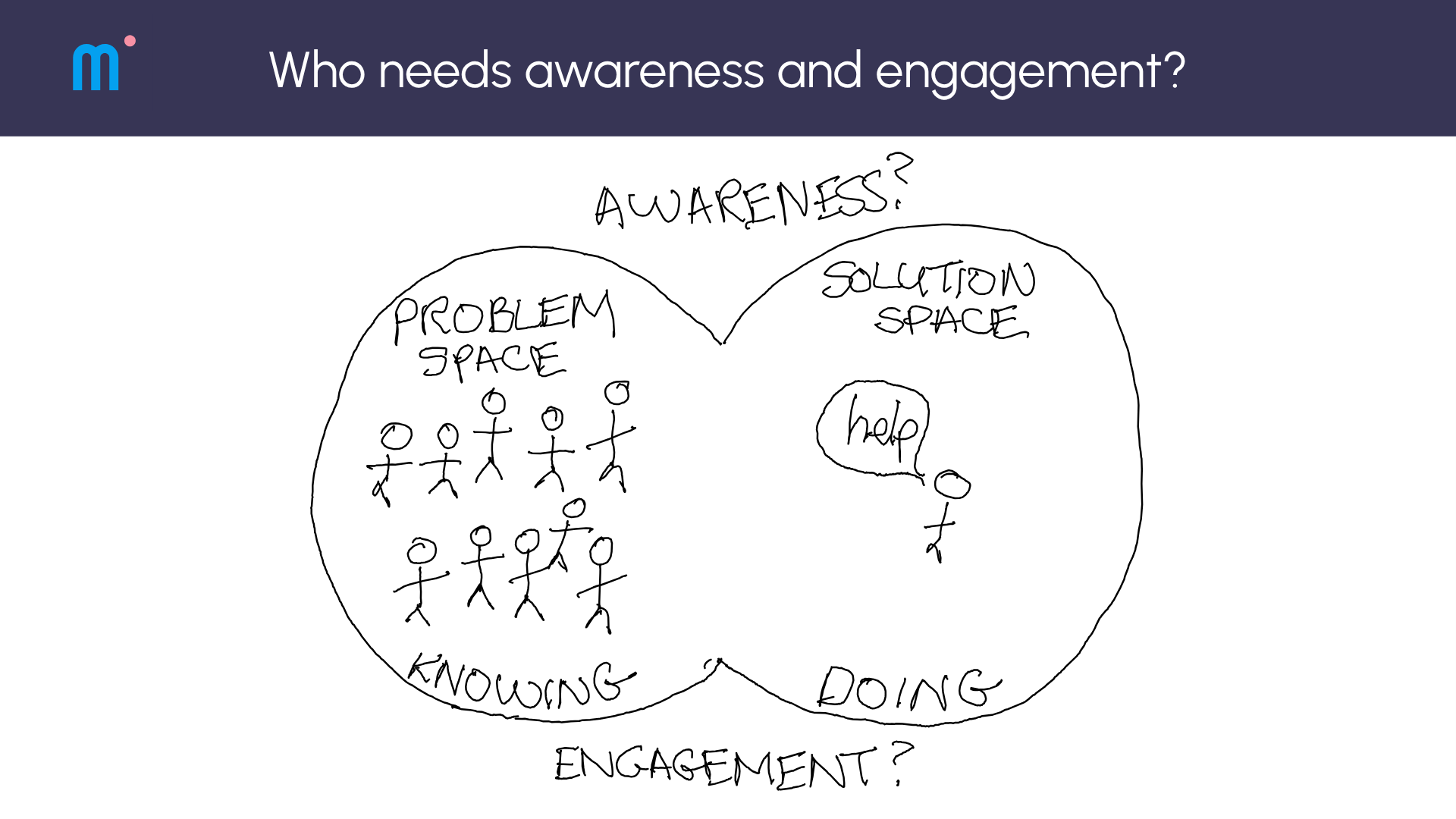
The Social Sciences and Humanities have knowledge critical for shaping a future that puts people first. The quality of our lives depends on it. That knowledge must make its way into the solution space where it can be put into action. Who is going to do it?
Invert the strategy
Knowledge and action are our two feet. You must move both in tandem to make progress, otherwise you end up going in circles.
Current plans — advocacy, capacity building, convening — are largely designed to bring solution space people into the problem space. Make the Social Sciences and Humanities more visible, more accessible, more connected, so that practitioners can find the knowledge they need. But practitioners don’t have the time or skills to do this. It’s hard to convince them otherwise.
The strategy needs to be inverted — a system of advocacy, capacity building, convening — to send researchers into the solution space.
When researchers join practitioners in the solution space, knowers and doers enter a three legged race where they move these feet in unison, not in separate lanes. For thirty five years, I’ve seen these paired athletes of the mind outlearn, outlast, and outperform everyone else. And produce five or six academic generations of distinguished researchers that did the same.
Now is the time to deploy this inversion at scale. Why?
Generous observation
Picture two rooms.
The first is filling up. Researchers, scholars, analysts, policy advisors — brilliant people with deep knowledge, working hard, producing important work. The walls are lined with the accumulated findings of decades of study: how societies navigate disruption, how labor markets restructure, how institutions adapt or fail to, how communities find their footing after the ground shifts beneath them. The conversation in this room is rich, rigorous, and necessary. People keep arriving. Funding keeps flowing. Mission accomplished.
The second room has other people in it. They are trying to do something about the disruption — trying to redesign a school-to-work transition that no longer works, or help a community adapt to an economy that has reorganized around them, or build the institutional structures that might actually get people through the AI transition with their dignity and opportunity intact. They are in the thick of it, trying to build the plane in the air. And the plane is on fire. Occasionally they open the door to the first room and call out for help. People come in to observe. Not to help. To study.
This is not an abstract problem. A while back, people working on an Indigenous clean energy project made an observation that stuck with me. More funding was allocated to study the project than was going into the implementation itself. The researchers were well-intentioned. The studies were useful. But from where the community stood, the resource flow was backwards. The people in the second room — doing the hard, slow, uncertain work of actually building something — were being observed more generously than they were being supported. It didn’t feel right.
We can’t help ourselves
The school-to-work transition is a live Canadian example of the same imbalance. Youth unemployment among recent graduates is at its highest September level since 2010. Nearly half of 2025 graduates reported feeling unprepared to apply for entry-level roles. AI has automated the bottom rungs of the career ladder — the low-stakes, repetitive practice that used to build the judgment, resilience, and professional instincts that make someone ready for the middle. The practice arena is gone, and nobody has rebuilt it yet.
There is SSH research that speaks directly to this. Historians have mapped exactly this pattern across previous industrial transitions. Sociologists understand how labor markets restructure and what supports people through the transition. Psychologists have studied how skills and professional identity develop under pressure. Philosophers have written carefully about what institutions owe the people they credential.
How is that knowledge helping the employers trying to onboard graduates who arrive underprepared? How is it helping the faculty who can see the gap widening and feel constrained by the structures around them? How is it reaching the students navigating the transition without a map? What would happen if this excellent scholarship sitting in the first room could be deployed to reimagine the education system — for the lives and livelihoods that depend on it?
It’s personal
It’s easy to get caught up in systems, models, and institutional roles. It all comes down to one person: the SSH graduate standing at the threshold of the solution space, with centuries of accumulated knowledge in their head and no clear path to making it matter economically. This is who it’s all about. SSH graduates need jobs.
Inverting awareness and engagement
The standard assumption is if we can make research more accessible, practitioners will pick it up and apply it. It assumes practitioners have the time, the background, and the incentive to engage with research literature, if it’s in a friendly enough format.
You know why I was never able to convince practitioners of that? Because they didn’t have the skills, and they didn’t have the time, and they knew it. All their energy needed to go into delivery.
Awareness and engagement campaigns aimed at practitioners — making SSH more visible, more accessible, better communicated — are working against the grain. The people best positioned to bring their knowledge to the solution space are the researchers themselves.
You could say practitioners need PhDs. If you mean another person with a PhD to help them, then absolutely! If you mean they should get an advanced degree of their own, then they’re researchers, aren’t they? And that’s the whole point.
Not my job
The challenge of applying research in the solution space belongs to researchers — for three reasons:
Researchers have the skills. A researcher who learns the vocabulary and urgent problems of a practitioner can identify which body of knowledge is relevant, how it applies, and what its limits are. A practitioner trying to navigate research literature is working in a foreign language, without the background to evaluate quality, relevance, or applicability. The asymmetry of expertise makes the researcher the natural bridge-builder — because the researcher's training is precisely what makes translation possible.
Researchers have the time. This sounds counterintuitive — aren't researchers busy too? If publications are being generated, the structure of research careers supports sustained periods of deep engagement with a problem that most practitioners simply cannot replicate. A graduate student embedded in a product team can spend months learning the context, if it is advancing their thesis work. Practitioners cannot spend months learning research literature. They have a product or service to deliver.
Researchers predictably benefit. When a researcher immerses in practice, they bring back richer, more grounded questions that produce better research. Reality is a more demanding and more generative collaborator than any peer reviewer. Practitioners only benefit if a meaningful improvement is made to a product or service.
Whose job is it?
The world view where “if we learn it, they will come” isn’t realistic.
Practitioners don’t have the skills, time or certainty of outcomes needed to invest in bringing research knowledge into the solution space all by themselves. Researchers do.
It’s the researchers who go the extra mile — the last mile — to connect their knowledge into the solution space that deliver proven value for practitioners, for graduates, and for the discipline itself.
It’s been done before
We know this approach works because it has worked — in a very different field, for more than three decades. IBM's Centre for Advanced Studies was founded in 1990 on a simple but radical premise: that the most valuable research questions are not generated inside universities and then applied to industry problems. They are discovered within industry problems, and then worked on jointly by graduate students, faculty, and industry technical staff working shoulder to shoulder.
I had the privilege of leading CAS Canada from 2015 to 2023, and our continued success depended on embracing the realities of the people in the solution space. Product teams were managing competing priorities, and looking for immediate solutions to pressing problems, expressed in the language of their day-to-day work.
Having researchers explore and derisk fundamental technical challenges prevented product teams from burning resources on workarounds and false paths. It also provided a hiring pipeline of unparalleled expertise impossible to obtain any other way.
But that wasn’t enough. Without a focus on immediate product priorities, progressively leaner product teams just couldn’t spare the people needed to collaborate.
Knowledge moves through people. The researcher who shows up in the solution space, who speaks the practitioner's language, who understands the urgent problem — that person is rare, valuable, and essential. And that person gets hired.
The more that research teams prioritized problems of immediate importance to IBM, the more technical staff became genuinely invested, not politely interested. They made time. They brought their best people into the conversations. They pushed for the partnerships to continue. They hired graduates. Immediate relevance did not compromise the research quality — it unlocked the human relationships that made the research possible.
The CAS model was built for technology. The need it addresses is universal. Everyone benefits when SSH researchers join practitioners in the solution space.
Always change a losing game
A distinguished research professor of psychology shared a concept that stuck with me: “always change a losing game”.
Here’s the losing game: a researcher produces excellent work and then considers their job done, leaving the translation, the application, the last mile to someone else — to communicators, to policy advisors, to practitioners who may never find their way to the work at all.
Why change the game?
For researchers and graduates, your career depends on it. The people who show up in the solution space with knowledge practitioners can use today get hired. The ones who are writing for each other are already being left behind.
For departments, your discipline's relevance depends on it. SSH is making an implicit argument every time it produces work — that this knowledge matters. That argument is only as strong as the evidence for it. The evidence lives in the solution space.
For federations, councils and associations, your advocacy depends on it. Advocacy backed by demonstrated impact is more powerful than advocacy backed by argument alone. Applied SSH research is not a complement to the advocacy strategy. It is the proof that makes the strategy work.
The last mile, together
This is not an invitation to do more — it is to complete what has already been started. To lay the last mile of track that makes everything that’s been built actually go somewhere.
The knowledge in SSH journals and conference proceedings is the railway. The solution space is the destination. The last mile — working shoulder-to-shoulder in the solution space, bringing knowledge to the people who need it, in a form they can use — that is the track that remains to be laid. And the people best equipped to lay it are the ones who built everything that came before. Not because it is easy. Because it is theirs to finish. Because no one else is going to do it. And no amount of research on knowledge mobilization, tech transfer, or commercialization is going to change that.
There's a temptation that all researchers face when confronted with the last mile problem. The temptation is to study it. To produce a framework for it. To write the paper that explains why it’s hard. That is what researchers know how to do, and it is genuinely valuable work. But it is not the work. The work is laying the track.
Here's the best part. If we start laying track, the practitioners who need it will show up to help us. Let’s lay that track together.
Of course, there are real challenges in doing this. My next article discusses what's needed and what stands in the way.
Working on this? Let's connect.